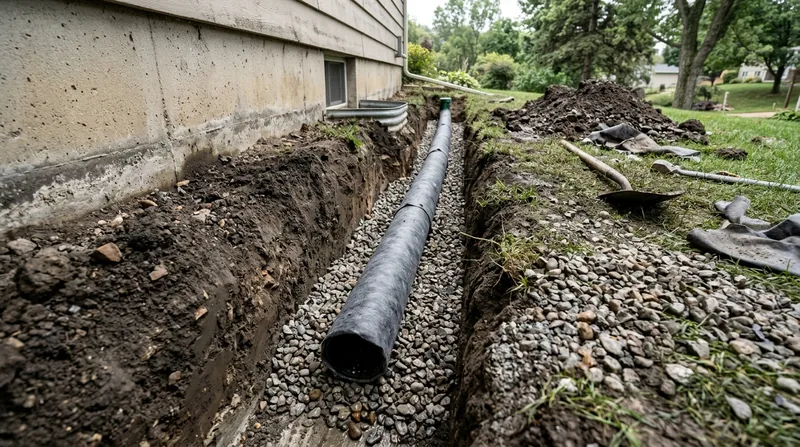




French Drain Installation in La Crosse: Intercepting Runoff Before It Reaches Your Foundation
If you own a home on the hillside streets below the bluffs, you already know how fast water moves in La Crosse. Spring melt and heavy summer thunderstorms send runoff down the loess silt loam slopes and straight into the foundation walls of houses in Washburn, Southside, and the older blocks of Downtown and Goosetown. French Drain Installation in La Crosse is the exterior line of defense: a graded gravel and perforated pipe system set along the footing that catches that water before hydrostatic pressure builds against your basement wall. We install these systems on 1880s brick foundations with old clay drain tile, on 1950s bungalows in Washburn, and on hillside walkout lots in Onalaska and Holmen where the grade sheds water hard. If you are still sorting out whether the problem is a crack or a drainage issue, start with our basement waterproofing overview, then we can scope the drain correctly.
Why French Drains Matter on La Crosse's Bluff-Slope Lots
The Driftless Area was never flattened by glaciers, so La Crosse sits on ridges that shed water violently into the valleys. When a July storm dumps two inches in an hour, that water hits the loess soil, saturates it fast, and then follows the path of least resistance: down the slope, along the foundation wall, and into the footing zone. On the older streets below the bluffs, the original weeping tile is often collapsed clay or has silted solid, so the water has nowhere to go but against the wall. That is when you see efflorescence, damp patches at the cove joint, and water after rain in a basement that was dry all winter.
- Hillside lots in La Crosse and Onalaska collect surface runoff from uphill neighbors and concentrate it at the foundation wall.
- Freeze-thaw cycles open mortar joints on 1920s brick foundations, giving water a second path in behind the parging.
- Old clay drain tile under Washburn and Goosetown houses collapses or silts in, so the footing drain stops working.
- Downspouts that dump within three feet of the wall add roof water to an already saturated grade.
- River-floodplain streets near the Mississippi and Black River push the water table up through old footings in wet years.
A properly built exterior drain intercepts that water at the wall and carries it to daylight or a sump basin, which takes the pressure off the foundation instead of letting it find a crack.
Key info: On a 1920s brick house on a Northside slope, we routinely find the original clay weeping tile crushed at the footing and the grade pitched back toward the wall. The fix is an exterior drain plus regrading, not another coat of sealer on the inside.
For the code side of drainage alterations, the City of La Crosse building department is the authority to check before any work that changes how water leaves the lot: City of La Crosse.
How We Install a French Drain on a La Crosse Foundation
We do not guess at the layout. We walk the grade, check where the water actually pools after a storm, and look at the footing depth and soil before we open any ground. On bluff-ridge lots in Holmen and West Salem, the drain often runs to daylight down the slope; on flatter city lots in La Crosse, it ties into a sump basin with a check valve on the discharge line. Either way, the pipe has to be graded correctly or it just becomes a buried trough that holds water against the wall.
- We mark utilities and confirm the footing depth and soil profile before excavation.
- We excavate a trench along the foundation wall to the footing, wide enough to work and deep enough to keep the pipe below the basement slab level.
- We line the trench with filter fabric so loess silt does not clog the gravel over time.
- We set washed gravel, lay the perforated pipe with the holes down and the grade falling toward the outlet, and wrap the fabric over the top.
- We backfill with gravel and soil, then regrade the surface so it pitches away from the wall.
- We tie the outlet to daylight, a dry well, or a sump basin, and test the flow before we close the trench.
If the interior footing drain is failing at the same time, we scope that alongside the exterior work so the two systems do not fight each other.
Local example: A split-level on a hillside lot in Onalaska had water entering at the cove joint every March thaw. The uphill grade was pushing runoff into the wall. We installed an exterior drain along the uphill side, extended the downspouts, and tied the outlet to daylight down the slope. The basement stayed dry through the next spring melt.
If the wall itself is moving or bowing, drainage alone will not fix it, and that is a different scope. See our French drain service in Onalaska for the hillside approach, and our exterior basement waterproofing page for membrane and dimple board work on the same excavation.
Exterior Drain Approaches We Use in the La Crosse Area
Not every lot takes the same system. The right choice depends on slope, soil, footing depth, and where the water can legally go. Here is how we match the approach to the property.
| Approach | Description | Best for |
|---|---|---|
| Gravel and perforated pipe to daylight | Fabric-wrapped trench along the footing, pipe graded to an outlet downslope. | Hillside lots in Onalaska, Holmen, and the bluff ridges with a legal outlet point. |
| Exterior drain tied to sump basin | Drain collects at the footing and discharges into a sump basin with a pump and check valve. | Flat city lots in La Crosse and Goosetown where daylight is not available. |
| Footing drain replacement | Remove collapsed clay tile and install new perforated pipe and gravel at the footing. | Pre-1940 houses in Washburn, Downtown, and Northside with failed original weeping tile. |
| Surface collection and regrading | Catch basins and swales that move surface water away from the wall before it soaks in. | Lots where downspouts and uphill runoff overload the footing zone. |
We pick the approach after we see the grade and the footing, not before, because the wrong outlet turns a drain into a liability.
French Drain Installation Cost in La Crosse: What to Expect
Most exterior French drain work in La Crosse starts around $25 per linear foot and moves up from there based on depth, access, and what we find at the footing. A straightforward run along one wall on a ranch in Holmen is at the low end. A deep excavation on a 1920s brick foundation in Goosetown with collapsed clay tile, tight side-yard access, and a sump basin added at the outlet sits well above that. The linear-foot number is the starting point, not the final invoice.
Factors that move the price: trench depth to the footing, whether the old drain tile has to come out, soil type (loess silt loam digs differently than glacial clay), access for equipment and spoil removal, whether the outlet runs to daylight or needs a sump basin and pump, and whether we are also installing a waterproof membrane and dimple board while the wall is open. Getting two or three estimates is smart, and it is the only way to compare scope, not just a number. Our full pricing overview breaks down the line items.
Key info: A 60-foot run on a flat Southside lot tied to an existing sump basin is a different job than a 60-foot run on a hillside in Stoddard that needs a daylight outlet and a regraded slope. Ask for the outlet plan in writing before you compare bids.
French Drain Installation Near Me: How to Vet a Contractor Near La Crosse
When you search for a waterproofing contractor near La Crosse, the list looks similar on every site. The differences show up in the license, the insurance certificate, and whether the estimator actually walks the grade or just quotes a linear-foot number from the truck. Here is what to check before you sign.
- Confirm the contractor is licensed and insured in Wisconsin, and ask for the certificate, not just a verbal yes.
- Get two or three written estimates with the outlet plan, pipe depth, and sump or daylight discharge spelled out.
- Ask for references from jobs in La Crosse, Onalaska, or Holmen on similar foundation types, and call them.
- Check whether a permit is required for the drainage alteration or sump discharge connection with the local building department, and confirm who pulls it.
- Ask how they handle spoil removal and regrading, because a drain that leaves a berm against the wall defeats the purpose.
A contractor who hesitates on the license or the outlet plan is telling you something. Reach out through our contact page and we will walk the property with you before any number is quoted.
French Drain Installation in La Crosse: Pricing Guide
| Service | Price | Details |
|---|---|---|
| Exterior French drain, standard run | Starting at $25/linear ft | Gravel, fabric wrap, perforated pipe, and backfill along one foundation wall, outlet to daylight or existing sump |
| Footing drain replacement | Starting at $40/linear ft | Removal of collapsed clay weeping tile, new perforated pipe and gravel at the footing, plus spoil haul-off |
| Drain tied to new sump basin | Starting at $1,800 | Sump basin, pump, check valve, and discharge line added at the outlet where daylight is not available |
| Complex or hillside job | On estimate | Deep excavation, tight side-yard access, bluff-slope outlet, or combined membrane and dimple board work needs an on-site look |
| Travel | Included | in La Crosse and surrounding areas, no separate call-out or mileage fee |
| Estimate | Free | Response within 24h at (608) 668-4037, no obligation to book |
Indicative pricing, the exact cost depends on square footage, finish, and site access. Free personalized estimate within 24h at (608) 668-4037.


